The Moon is not just a planet in Vedic astrology. It is the mind itself, the seat of feeling, memory, and the entire inner life that shapes how you experience every other part of your chart.
| Sanskrit Names | Chandra, Soma, Indu, Shashi, Oshadhipati |
| Element | Water (Jala) |
| Nature | Benefic when waxing (Shukla Paksha); weaker when waning (Krishna Paksha) |
| Own Sign | Cancer (Karka) |
| Exalted In | Taurus (Vrishabh) at 3 degrees |
| Debilitated In | Scorpio (Vrishchik) at 3 degrees |
| Day of the Week | Monday (Somavar) |
| Gemstone | Pearl (Moti) |
| Mahadasha Duration | 10 years (Vimshottari Dasha) |
| Karaka For | Mind, mother, emotions, public, water, fertility, memory |
What Is the Moon in Vedic Astrology?
The Moon is called Chandra in Sanskrit. It is a watery and naturally benefic planet. Of all nine planets, the Moon moves the fastest, completing a full cycle through all 12 zodiac signs in just 27 to 28 days.
The Moon has one quality that no other planet in Jyotish carries: its strength changes with its phase. A waxing Moon in Shukla Paksha (the bright fortnight, from new moon to full moon) is strong. A waning Moon in Krishna Paksha (the dark fortnight, from full moon to new moon) gets progressively weaker, especially when it comes too close to the Sun near Amavasya (new moon). Track the current lunar phase using the Moon Phase Calculator.
The Moon owns one sign, Cancer (Karka). It is exalted in Taurus (Vrishabh) at 3 degrees, where it can be calm, stable, and comfortable. It is debilitated in Scorpio (Vrishchik) at 3 degrees, where the intensity of Scorpio makes it harder for the Moon to be settled and nurturing. The Moon is also the only planet in Jyotish with no natural enemies. Every other planet has at least one. The Moon is neutral or friendly with all.
In Vedic astrology, most people identify themselves by their Moon sign, called Rashi, rather than the Sun sign used in Western astrology. Your Moon sign shows how you feel and react in daily life. It is also the starting point for the Vimshottari Dasha system, which is the main timing tool in Vedic astrology. The Nakshatra your Moon was in at the time of your birth decides which Dasha you were born into and the order of all planetary periods that follow. This is why knowing your exact Moon sign and Nakshatra matters so much.
The Story of Chandra
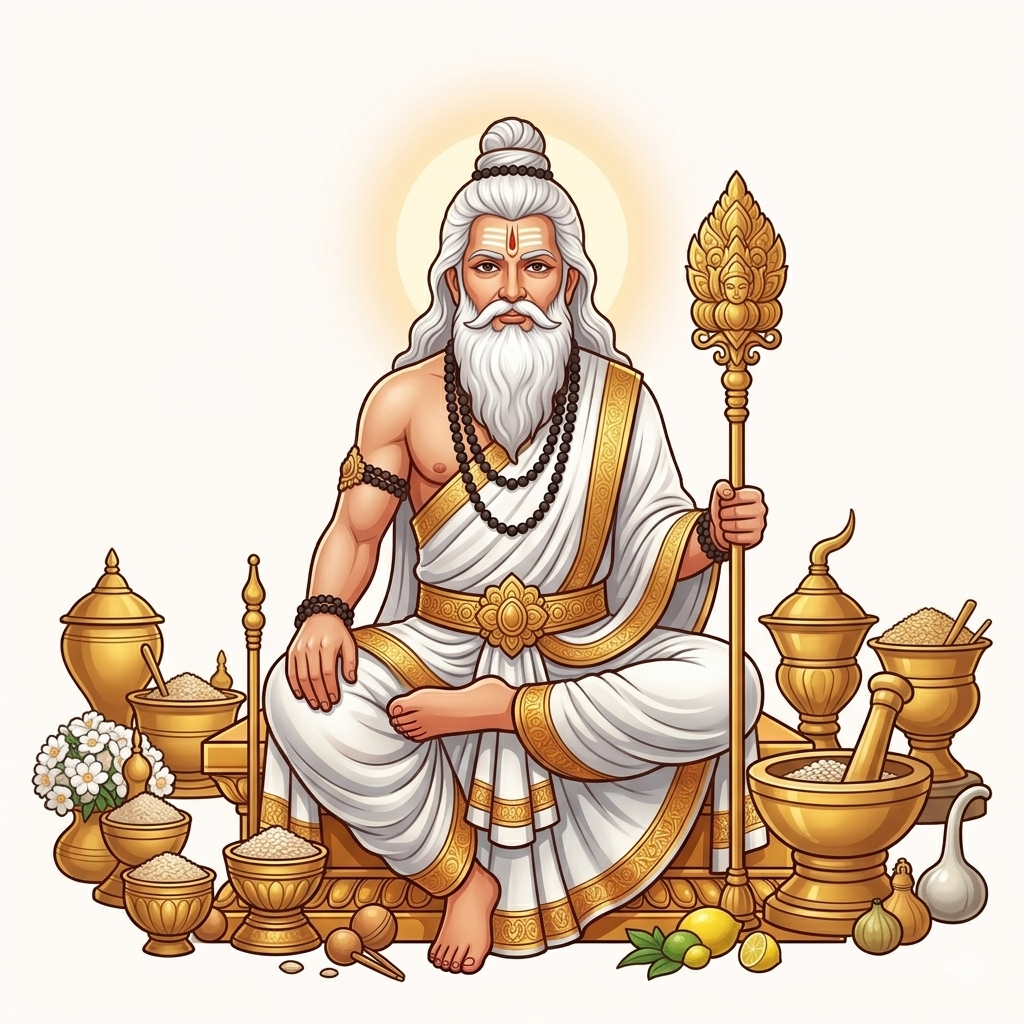
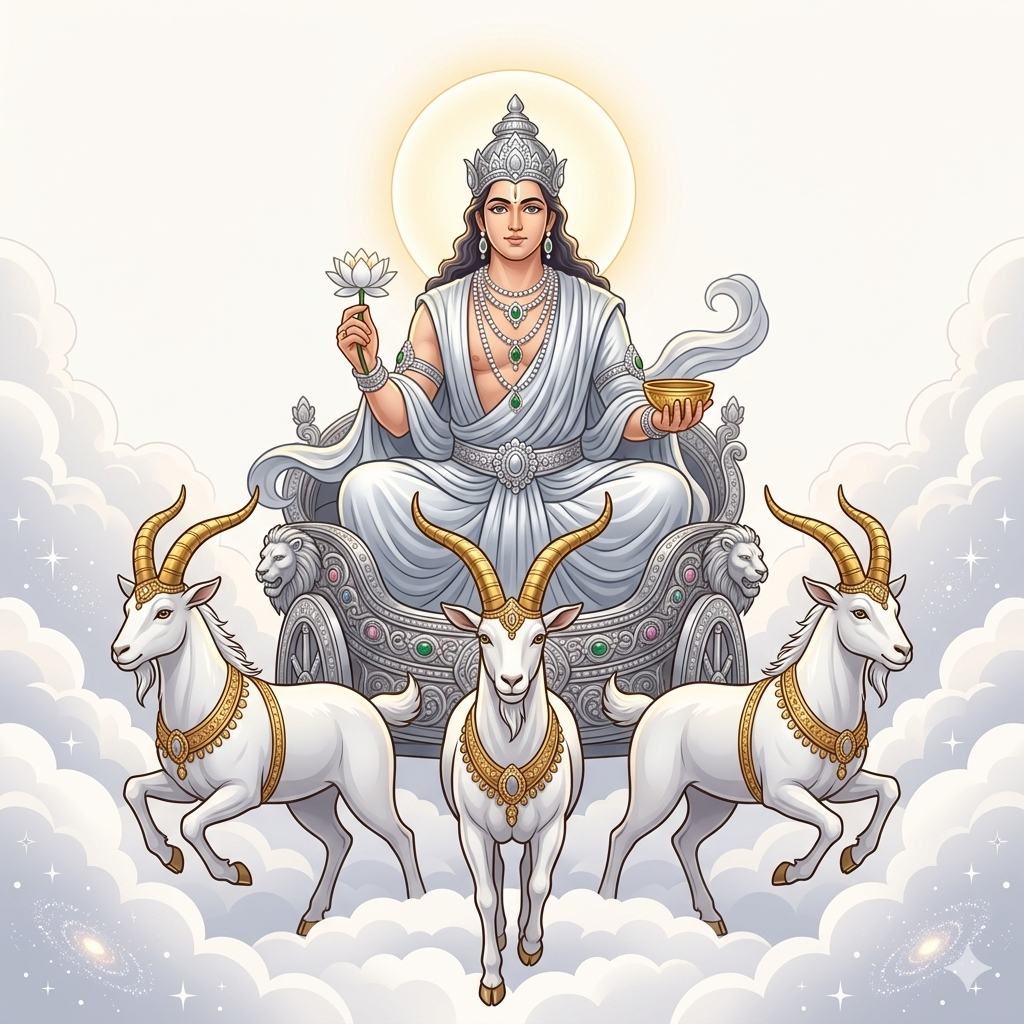
In Hindu mythology, Chandra Dev is described as a young, radiant deity who rides a silver chariot across the night sky. He is married to the 27 daughters of Daksha Prajapati, who represent the 27 Nakshatras. Chandra was supposed to spend equal time with each wife, but he favoured Rohini above all others and kept returning to her. The other wives complained to their father, who cursed Chandra to lose his light. Chandra prayed to Lord Shiva, who softened the curse. Instead of losing his light forever, Chandra now waxes and wanes each month. This is the origin of the lunar cycle in Vedic tradition.
What Does the Moon Represent in Astrology?
The Moon is the Karaka (significator) for several areas of life. Its placement and condition in the chart shape how these themes unfold.
Mind and Emotions
In Vedic astrology, the Moon IS the mind. Not the thinking mind (that is Mercury) but the feeling mind: your moods, reactions, instincts, and how you handle what life throws at you each day. Where the Moon sits in your chart shows where you are most emotionally invested and most sensitive. A strong Moon gives you a stable, clear inner world. A weak Moon means your feelings are harder to manage, and anxiety tends to take over.
Mother and Family
The Moon is the main planet for the mother in Jyotish. How the Moon is placed in your chart tells you a great deal about your relationship with your mother, how present and supportive she was in your life, and how her influence shaped who you are emotionally. A strong Moon usually means a close, warm bond with the mother. A Moon aspected by Saturn or Rahu often points to a more difficult or complicated relationship.
The Public and Masses
The Moon also governs the public, collective mood, and how a person connects with large groups of people. Politicians, actors, and public figures with a strong Moon tend to have a natural feel for what people want to hear and how to emotionally connect with a crowd. It also rules all water, body fluids, rain, and the tides. In the body, it governs blood, the chest and lungs, and the reproductive system.
Your Birth Star and Dasha Timing
The Nakshatra your Moon occupies at birth is called your Janma Nakshatra or birth star. This is one of the most important points in your entire Vedic chart. It decides the starting Dasha and the sequence of all nine planetary periods across your lifetime. Without knowing your Moon’s Nakshatra, no Dasha calculation is possible. The Moon rules three Nakshatras: Rohini, Hasta, and Shravana. To find your birth star, use the Nakshatra Calculator.
Strong Moon vs Weak Moon: What It Looks Like in Real Life
The condition of your Moon shapes how stable your inner world is, how well you handle emotions, and how your relationship with your mother plays out in your life.
| Area | Strong Moon | Weak or Afflicted Moon |
| Emotional Stability | Even-tempered, handles stress well, does not get overwhelmed easily | Mood swings, gets upset quickly, finds it hard to calm down |
| Mother | Close, loving bond with mother; strong support from family | Difficult or distant relationship with mother |
| Mental Clarity | Clear mind, good memory, thinks before reacting | Anxiety, overthinking, poor memory, restless mind |
| Relationships | Caring, emotionally available, easy to connect with | Clingy or cold, insecure in love, difficulty trusting |
| Health | Good digestion, healthy lungs, stable energy | Digestive issues, chest or lung problems, hormonal imbalance |
| Creativity | Good imagination, creative ideas flow naturally, restful sleep | Blocked creativity, lack of inspiration, disturbed sleep |
| Public Life | Naturally connects with people, well-liked, good social sense | Struggles to read a room, socially awkward, often misunderstood |
The Moon is strongest in Taurus (exalted), Cancer (own sign), and the 4th house where it gets directional strength. A Moon during Shukla Paksha, more than 72 degrees away from the Sun, is considered full strength. Moon with Jupiter, especially in a mutual Kendra position forming Gaja Kesari Yoga, is well supported and emotionally stable. The Moon is weak when in Scorpio (debilitated), close to the Sun near Amavasya, or under heavy aspect from Saturn, Rahu, or Ketu.
Remedies to Strengthen the Moon
Moon remedies work on the same principle: calm the mind, honour the mother, and bring consistency into daily life. The Moon responds to routine and gentleness more than dramatic intervention.
Devotional Practices
- Shiva worship on Mondays: The Moon rests on Lord Shiva’s head. Offering milk or water to a Shivalinga on Mondays, especially on Pradosh (the 13th lunar day), is the most direct and traditional Moon remedy.
- Moon Beej Mantra: Om Shraam Shreem Shraum Sah Chandramase Namah, chanted 108 times on Mondays, ideally during Shukla Paksha. For daily practice, Om Chandraya Namah is simpler and equally valid.
- Goddess Parvati worship: Goddess Parvati is connected to Moon energy as the cosmic mother. Worshipping her, particularly through the Durga Saptashati, is recommended for strengthening the mind and emotional wellbeing.
Lifestyle Practices
- Honour the mother: Classical Jyotish texts say this directly: genuine care and respect for the mother strengthens the Moon in the chart over time. Even where the relationship is not easy, making the effort matters.
- Fast on Mondays: Somvar Vrat, fasting on Mondays, is one of the most widely observed Hindu fasts and is specifically for Chandra. Donating white items such as rice, milk, white cloth, or silver on Mondays is the traditional charity for Moon.
- Spend time near water: Being near rivers, the sea, or lakes on Mondays is calming and activating for Moon energy. Eating cooling foods like milk, curd, coconut, and rice, and drinking water stored in a silver vessel, all support the Moon.
- Meditate at moonrise: The Moon is most powerful at moonrise and on Purnima (full moon). Even 10 minutes of sitting quietly at these times gives the mind the stillness it needs.
Gemstone
Pearl is the gemstone for the Moon. It calms the mind, strengthens emotional stability, and supports the relationship with the mother. It is worn on the little finger of the right hand, set in silver, on a Monday morning. Pearl is best suited for Cancer, Scorpio, Pisces, and Aries Ascendants, where the Moon rules beneficial houses. For Capricorn and Aquarius Ascendants, where the Moon rules more difficult houses, Pearl needs careful assessment before wearing. Always consult a qualified Vedic astrologer before wearing any planetary gemstone.
The Four Chandra Yogas
The Moon is the only planet in Jyotish with a full set of yogas based entirely on its position. These yogas show how well-supported the mind is by the rest of the chart. The Sun, Rahu, and Ketu are not counted in any of these four yogas.
| Yoga | How It Forms | What It Means |
| Sunapha Yoga | Any planet (not Sun, Rahu, Ketu) in 2nd house from Moon | Self-earned wealth, intelligence, good reputation. 31 varieties. |
| Anapha Yoga | Any planet (not Sun, Rahu, Ketu) in 12th house from Moon | Good health, attractive personality, generous nature, comfort in life. 31 varieties. |
| Durudhura Yoga | Planets on both 2nd and 12th sides of Moon | Combines Sunapha and Anapha. Very auspicious. 180 varieties. |
| Kemdrum Yoga | No planets in 2nd or 12th from Moon and Moon not in Kendra or aspected | Classical texts describe difficulty and mental instability. Many cancellation conditions exist in practice. |
Anapha Yoga, the most commonly asked-about of the four, gives good health, a good reputation, physical attractiveness, and a generous nature. The strength depends on which planet forms it. Jupiter in the 12th from Moon gives the strongest Anapha. There are 31 possible varieties depending on the planet involved.
Kemdrum Yoga gets a great deal of fear attached to it, but in practice it is often cancelled. If the Moon is in a Kendra house (1st, 4th, 7th, or 10th from the Ascendant), or aspected by a benefic planet, or exalted, the Kemdrum effect is reduced significantly. The real meaning is that the mind must build its own inner strength rather than depending on others. That can produce resilience and independence just as easily as difficulty. Check which yogas are present in your chart using the Raj Yoga Calculator.
Moon Mahadasha: The 10-Year Period
Moon Mahadasha lasts 10 years. Because the Moon governs the mind and feelings, this decade tends to bring the inner world forward. Things you have been feeling but not acting on tend to come up. Relationships, creativity, home life, and your connection with family all become more important during this time. A well-placed Moon makes this a productive and emotionally rich period, with more creativity, stronger connections to people, and greater clarity about what you want in life. A weak or afflicted Moon can make this period emotionally demanding, with mood instability and difficult family dynamics surfacing. The Moon-Jupiter sub-period within these 10 years is usually the most positive and settled stretch. Use the Dasha Calculator to check when your Moon Mahadasha starts or whether you are currently in it.
Final Thoughts
The Moon teaches one thing above all: emotions are not a problem to be solved. They are information. A strong Moon does not mean a person without pain. It means a person who can feel what they feel, process it, and move forward without getting stuck. A weak Moon does not mean a broken person. It means someone who has to work harder to find emotional ground, and that work often builds a depth of understanding that a naturally stable Moon never needs to develop.
Whether your Moon is strong or weak, the path is the same. Take care of your mother. Stay close to water. Keep your home calm. Let yourself feel things fully, then let them move. The Moon waxes and wanes every month. So do you. That is not a flaw. That is how it works.
Frequently Asked Questions
In Vedic astrology, the Moon sign (Rashi) is used because it governs the mind and daily experience. It is more personal and changes frequently, unlike the Sun sign which remains the same for about a month. The Moon also forms the basis of the Dasha system, which is essential for prediction.
When the Moon is in Taurus, it is exalted and considered very strong. This placement gives emotional stability, calmness, and a love for comfort and beauty. It is one of the most favourable Moon placements in Vedic astrology.
Signs include anxiety, mood swings, sleep issues, emotional isolation, and challenges with the mother. A debilitated Moon in Scorpio, combustion, or affliction by Saturn, Rahu, or Ketu can weaken it. Kemdrum Yoga is another classical indicator of a weak or unsupported Moon.
Kemdrum Yoga occurs when no planet is placed in the 2nd or 12th house from the Moon. While classical texts describe difficulties, it is often cancelled by other positive factors. It usually indicates a need for inner emotional strength rather than guaranteed hardship.
Sunapha Yoga forms when a planet is in the 2nd house from the Moon and brings wealth and reputation. Anapha Yoga forms when a planet is in the 12th house from the Moon and brings health, attractiveness, and comfort. When both occur, it becomes Durudhura Yoga, combining the benefits of both.
Moon Mahadasha lasts 10 years. It focuses on emotions, relationships, home, and creativity. A strong Moon brings emotional fulfilment and harmony, while a weak Moon may lead to emotional challenges and fluctuating moods.
Pearl is generally suitable for Cancer, Scorpio, Pisces, and Aries Ascendants. It is usually not recommended for Capricorn and Aquarius Ascendants. Always consult a qualified astrologer before wearing gemstones to ensure suitability.
Your Moon sign is determined by the Moon’s position at your birth time and place. Since the Moon changes signs every 2–3 days, accurate birth time is essential. You can find it using a Moon sign calculator by entering your birth details.