The 12 Houses of the Vedic Birth Chart
The blueprint of your life — each house governs a distinct and essential area of human experience.
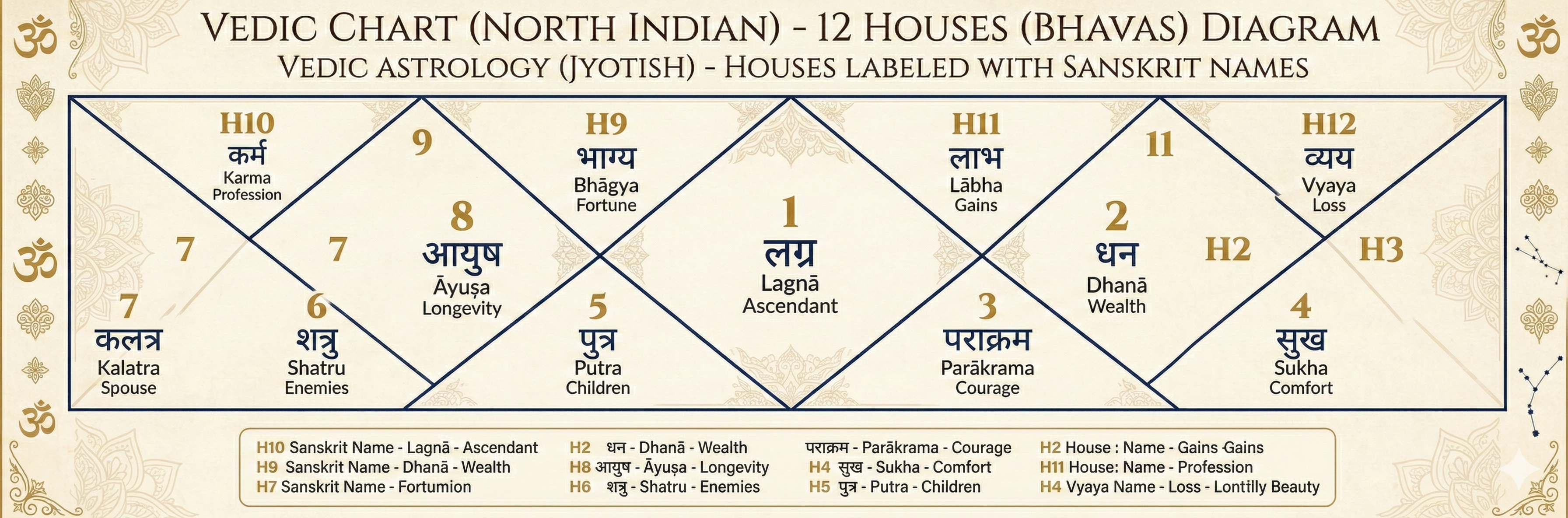
What Are the 12 Houses in Vedic Astrology?
The 12 houses (Bhavas) of a Vedic birth chart are 12 divisions of the sky as seen from the place of birth at the exact moment of birth. Each house represents a specific, distinct area of life — from the body and personality (1st house) to spiritual liberation (12th house). The houses are fixed in sequence, but the zodiac signs that occupy them rotate based on your Ascendant (Lagna), which changes every two hours.
The Ascendant — the zodiac degree rising on the eastern horizon at your birth — becomes the threshold of the First House. All subsequent houses follow in order, each occupied by a zodiac sign. The planet ruling that sign becomes the lord of that house — and the lord's placement in the chart tells you how that area of life functions. This is why birth time is so critical: even 30 minutes changes the Ascendant, which changes every house and every house lord in the chart.
In Vedic astrology, the houses and their lords are as important as the planets themselves. A planet's results depend heavily on which houses it rules and where those house lords are placed. This layered system — planets, signs, houses, and their mutual relationships — is what makes Vedic astrology one of the most precise and personally specific predictive systems ever developed.
Not sure of your Ascendant or house positions? Enter your birth date, time, and place on the Atri Astrology app and your complete birth chart is generated free — showing all 12 houses, every planet's placement, and your current Dasha period.
Explore Each House

1st House
House of Self

2nd House
House of Wealth & Family

3rd House
House of Courage & Communication

4th House
House of Home & Mother

5th House
House of Children, Intelligence & Creativity

6th House
House of Enemies, Debts & Health Challenges

7th House
House of Marriage & Partnership

8th House
House of Transformation & Longevity

9th House
House of Fortune, Dharma & Higher Wisdom

10th House
House of Career & Public Life

11th House
House of Gains & Aspirations

12th House
House of Loss, Liberation & Spiritual Release
The 12 Houses — Complete Overview
Note: "Natural Sign" and "Natural Karaka" below refer to the Kalapurusha symbolic correspondence, not the actual sign in an individual chart.
| # | House Name | Sanskrit | Governs | Natural Zodiac | Natural Karaka |
|---|---|---|---|---|---|
| 1 | House of Self | Lagna Bhava | Body, health, appearance, vitality, character | Aries | Sun |
| 2 | House of Wealth & Family | Dhana Bhava | Wealth, speech, family, food, stored assets | Taurus | Jupiter, Venus, Mercury |
| 3 | House of Courage & Communication | Sahaja Bhava | Courage, effort, younger siblings, skills | Gemini | Mars |
| 4 | House of Home & Mother | Sukha Bhava | Mother, home, property, vehicles, inner happiness | Cancer | Moon |
| 5 | House of Children, Intelligence & Creativity | Putra Bhava | Children, intelligence, mantra, past-life merit | Leo | Jupiter |
| 6 | House of Enemies, Debts & Health Challenges | Shatru Bhava | Enemies, debts, disease, service, litigation | Virgo | Mars, Saturn |
| 7 | House of Marriage & Partnership | Kalatra Bhava | Marriage, spouse, partnerships, contracts | Libra | Venus |
| 8 | House of Transformation & Longevity | Mrityu Bhava | Longevity, death, transformation, occult | Scorpio | Saturn, Ketu |
| 9 | House of Fortune, Dharma & Higher Wisdom | Dharma Bhava | Fortune, father, guru, higher wisdom, dharma | Sagittarius | Jupiter |
| 10 | House of Career & Public Life | Karma Bhava | Profession, status, authority, and karma in society | Capricorn | Sun, Saturn |
| 11 | House of Gains & Aspirations | Labha Bhava | Gains, income, fulfilment of desires, and elder siblings | Aquarius | Jupiter |
| 12 | House of Loss, Liberation & Spiritual Release | Vyaya Bhava | Loss, expenditure, bed pleasures, liberation, foreign lands | Pisces | Saturn, Ketu, Venus |
House Classifications in Vedic Astrology
| Classification | Houses | Meaning | Key Effect |
|---|---|---|---|
| Kendra (Angular) | 1st, 4th, 7th, 10th | Four pillars of the chart — most powerful positions | Planets placed here give their strongest results; Kendra lords are powerful |
| Trikona (Trine) | 1st, 5th, 9th | Auspicious houses of dharma and divine grace | Trikona lords are generally the most auspicious functional planets in a chart; results can be modified if heavily afflicted or if the lord also owns a Dusthana house |
| Upachaya (Growing) | 3rd, 6th, 10th, 11th | Houses that improve with time and effort | Malefic planets give better results here than in other houses |
| Dusthana (Difficult) | 6th, 8th, 12th | Houses of obstacles, transformation, and loss | Challenges these houses bring are also pathways to growth and liberation |
| Maraka (Death-Inflicting) | 2nd, 7th | Houses whose lords can time end of life in Dasha | Normal houses in everyday life; longevity markers in advanced analysis |
| Moksha (Liberation) | 4th, 8th, 12th | Houses of spiritual liberation and inner life | Deep spiritual significance; Ketu in 12th considered one of most Moksha-oriented placement |
| Kama (Desire) | 3rd, 7th, 11th | Houses of desire and its fulfilment | 7th: desire for partnership; 11th: fulfilment; 3rd: effort toward desire |
| Artha (Wealth) | 2nd, 6th, 10th | Houses of material resources and earning | Career, wealth, and the practical means of sustaining life |
| Dharma (Purpose) | 1st, 5th, 9th | Houses of life purpose and righteous action | Soul mission, spiritual merit, and the divine purpose behind one's existence |
| Panapara (Succedent) | 2nd, 5th, 8th, 11th | Houses following the Kendras — consolidating and sustaining | Planets here give delayed but sustained results; these houses consolidate what Kendra planets initiate |
| Apoklima (Cadent) | 3rd, 6th, 9th, 12th | Houses following the Panapara — dispersing and completing | Planets here have declining positional strength; the 9th is a special exception as a Trikona, giving it high auspiciousness despite its Apoklima position |
How to Read the Houses in Your Chart
- Find your Ascendant (Lagna) — Your Ascendant is the most important point in your chart — the sign rising on the eastern horizon at your birth. Every house position flows from it. Find it free on the Atri Astrology app with your birth date, time, and place.
- Identify the sign in each house — Each house has a zodiac sign occupying it. The sign colours the house with its qualities — for example, fiery Aries in the 7th creates a different relationship dynamic than watery Cancer in the 7th.
- Find the lord of each house — The planet ruling the sign occupying a house is that house's lord. Its placement and strength in the chart tells you how that life area functions.
- Note planets placed in houses — Any planet sitting in a house directly activates and influences that house's themes. Multiple planets in a house (stellium) intensify that area of life significantly.
- Check aspects of each house — In Vedic astrology, planets aspect other houses from where they sit. Jupiter aspects the 5th, 7th, and 9th from itself; Saturn aspects the 3rd, 7th, and 10th; Mars aspects the 4th, 7th, and 8th. These aspects influence the houses they fall on.
- Layer in divisional charts — The Navamsa (D9) gives detail on marriage and spiritual life. The Dashamsha (D10) gives career details. Each Bhava can be further examined through the relevant divisional chart.
Frequently Asked Questions
Bhava is the Sanskrit word for 'house' in Vedic astrology. The 12 Bhavas divide the birth chart into 12 life areas. Each Bhava has a Sanskrit name (e.g., Lagna Bhava for 1st, Dhana Bhava for 2nd), a natural ruling sign, a natural Karaka planet, and a lord determined by which sign occupies it in the individual chart.
The Ascendant — which determines all 12 houses — changes the zodiac sign every two hours. A 30-minute error in birth time can produce a completely different Ascendant and therefore entirely different house positions for every planet. Without an accurate birth time, house analysis is unreliable. Moon sign and Nakshatra can be calculated with less precise timing, but for complete chart analysis, birth time is essential.
An empty house simply means no planet is stationed there. The house is still fully active — governed by its lord (the planet ruling the sign occupying that house), any planets aspecting it, and the natural Karaka of that house. Empty houses are common and normal. Most people have 5-7 empty houses. The lord's condition tells you everything about how that area of life functions.
Kendra houses (1st, 4th, 7th, 10th) are the four angular pillars of the chart — the most powerful positional strength. Trikona houses (1st, 5th, 9th) are the most auspicious houses of divine grace and dharma. The 1st house is both a Kendra and Trikona, making it the most important. Planets in Kendra houses are powerfully placed; lords of Trikona houses are generally the most auspicious functional planets in a chart. The combination of Kendra and Trikona lordship in one planet creates Raja Yoga — though which planet qualifies as such depends entirely on the Ascendant.
Raja Yoga (literally 'royal combination') forms when the lord of a Kendra house and the lord of a Trikona house are the same planet, or when they conjoin, mutually aspect, or exchange signs. Since Kendra lords have power and Trikona lords have auspiciousness, their combination produces exceptional results. Crucially, whether a planet is a Kendra or Trikona lord depends entirely on the Ascendant — the same planet may form Raja Yoga for one Lagna and not another. The strength of the planets involved and freedom from heavy affliction determine how powerfully the Yoga manifests.
Dusthana houses (6th, 8th, 12th) are traditionally considered difficult — they govern enemies, transformation/death, and loss respectively. However, they are not simply 'bad.' The 6th house in an Upachaya context gives victory over enemies; the 8th house governs longevity and occult wisdom; the 12th house governs Moksha and foreign settlement. Additionally, Viparita Raja Yoga — formed when Dusthana lords occupy other Dusthana houses — is considered highly auspicious, producing unexpected positive results after periods of difficulty.
Every house is occupied by a zodiac sign, and the planet that rules that sign becomes the lord of that house. The lord's placement in the chart — which house it sits in, whether it is strong or weak, what planets are near it, and what aspects it receives — tells you how that house's life area functions. For example, if Capricorn occupies your 7th house, Saturn is your 7th lord. Saturn placed in the 10th in good strength links marriage and career — both tend to build steadily over time.