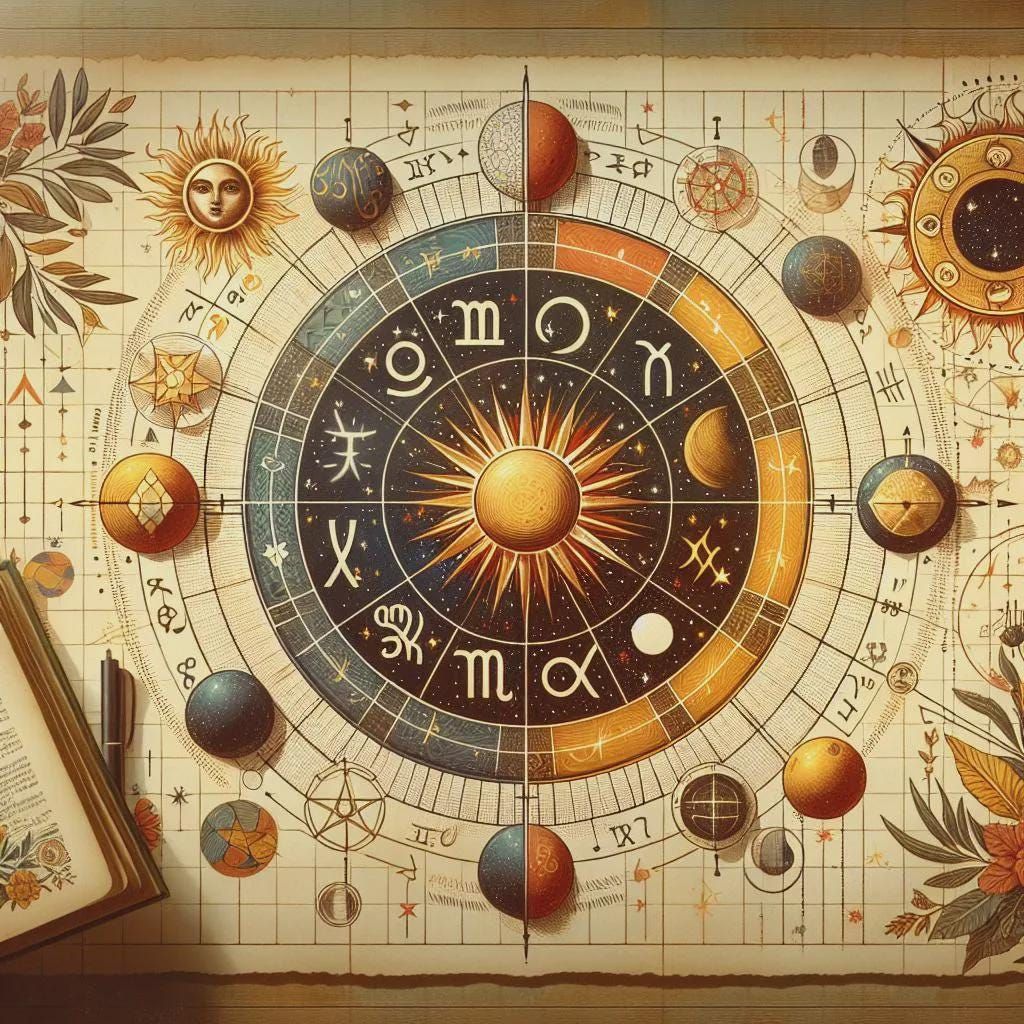
Your birth chart shows the big picture. Divisional charts zoom into the details. Once you understand what they are and how they work, a whole new layer of Vedic astrology opens up.
What Is a Divisional Chart?
When you visit a doctor for a general check-up, they get an overall picture of your health. But if there is a specific concern, say about the heart, they do not just look at the general report. They run an ECG. If the concern is about bones, they order an X-ray. If it is about blood, they run targeted blood tests. Each of these tests does not replace the general check-up. It goes deeper into one specific area that the general report can only see in broad strokes.
Divisional charts work exactly the same way. Your birth chart, the D1 or Rashi chart, is the general check-up. It gives the overall picture of your life: your personality, your general health, your broad career trajectory, your family situation. But when an astrologer wants to look specifically at marriage, they pull up the D9 Navamsa chart. When they want to understand career in detail, they look at the D10 Dashamsa. When the question is about children, they examine the D7 Saptamsa. Each divisional chart is a targeted examination of one specific area of life.
The divisional charts do not replace the birth chart. They are derived from it and always read alongside it. A planet that is strong in the D1 and also strong in the relevant divisional chart gives its full results in that area of life. A planet that looks promising in the D1 but is weak in the divisional chart will deliver more muted results in that specific domain. This is what makes Vedic astrology uniquely precise: it does not just give you a general read. It gives you a focused read for each area of life separately.
| What they are | Additional charts derived from the main birth chart by dividing each zodiac sign into equal parts |
| Sanskrit name | Varga (meaning division or portion). Also called Amsha charts. |
| Classical source | Described by Sage Parashara in the Brihat Parashara Hora Shastra (BPHS) |
| How many | Parashara describes 16 divisional charts (Shodashavarga). Practical astrology commonly uses 6 to 10. |
| Most important | D1 (birth chart) and D9 (Navamsa) are the two charts read in almost every session |
| Requires | Exact birth time. The more precise the time, the more accurate the divisional charts. |
How Divisional Charts Are Calculated
Each zodiac sign spans 30 degrees in the sky. A divisional chart is created by dividing each of those 30 degrees into a specific number of equal parts. The D9 Navamsa, for example, divides each sign into 9 parts of 3 degrees 20 minutes each. The D10 Dashamsa divides each sign into 10 parts of 3 degrees each. The D60 Shastiamsha divides each sign into 60 parts of just 30 arc minutes each.
When a sign is divided this way, each part is assigned to a specific zodiac sign following a set formula described in classical texts. The planets in your birth chart are then placed into the new chart based on which division they fall into. A planet sitting at 8 degrees of Aries, for example, falls into the 3rd division of Aries in the Navamsa, which corresponds to a specific sign based on the Navamsa calculation formula. The result is a completely new chart with the same nine planets but in different signs and houses.
This is why an accurate birth time is so important for divisional charts. In the D1 birth chart, a few minutes of difference may not change planet positions. But in the D60 Shastiamsha, where each division is only half a degree, even a two-minute difference in birth time can shift an entire planet to a different sign. The deeper the divisional chart, the more sensitive it is to birth time accuracy.
The 16 Divisional Charts: Complete Reference
Parashara describes 16 standard divisional charts, collectively called Shodashavarga. Here is the complete list with what each one examines.
| D.No. | Chart Name | Division | What It Shows |
| D1 | Rashi (Lagna Chart) | 1 part | The main birth chart. Overall life, personality, health, and all general indications. Foundation of everything. |
| D2 | Hora | 2 parts | Wealth and the ability to earn and accumulate money. Sun hora and Moon hora show different financial tendencies. |
| D3 | Drekkana | 3 parts | Siblings, courage, initiative, and short-distance travel. Used also for co-born and enterprise in life. |
| D4 | Chaturthamsa | 4 parts | Property, fixed assets, home comfort, and fortune. Gives detailed information about land and real estate matters. |
| D7 | Saptamsa | 7 parts | Children and progeny. Fertility, the number of children, and the quality of the relationship with children. |
| D9 | Navamsa | 9 parts | Marriage, spouse, dharma, and the second half of life. The most important divisional chart after D1. Always read alongside it. |
| D10 | Dashamsa | 10 parts | Career, profession, public life, and achievements. The primary chart for detailed career analysis. |
| D12 | Dwadashamsa | 12 parts | Parents, inherited traits, and lineage. Shows the quality of the relationship with mother and father in detail. |
| D16 | Shodashamsa | 16 parts | Vehicles, luxury, material comforts, and conveyances. Also connected to happiness from assets. |
| D20 | Vimsamsa | 20 parts | Spiritual life, worship, and upasana. Used specifically for understanding a person’s spiritual development. |
| D24 | Siddhamsa (Chaturvimsamsa) | 24 parts | Education, learning, and academic achievement. Used to assess the quality and depth of formal learning. |
| D27 | Saptavimsamsa (Bhamsa) | 27 parts | Strength, vitality, and inherent power of the chart. Shows the overall strength and weakness of the native. |
| D30 | Trimsamsa | 30 parts | Misfortunes, difficulties, and health challenges. Shows specific vulnerabilities and areas of suffering in life. |
| D40 | Khavedamsa | 40 parts | Maternal lineage and its auspicious or inauspicious influences on the native. |
| D45 | Akshavedamsa | 45 parts | Paternal lineage, general happiness, and prosperity. Confirms overall chart indications. |
| D60 | Shastiamsha | 60 parts | Past life karma, hidden influences, and the deepest layer of the chart. Requires extremely precise birth time. |
Which Group of Charts Do Most Astrologers Use?
Not all 16 charts are used in every reading. Classical tradition organises them into four groups based on the depth of analysis required. The Shadvarga (6 charts: D1, D2, D3, D9, D12, D30) is used for marriage matching and major life decisions. The Saptavarga (7 charts) adds D7 for progeny analysis. The Dashavarga (10 charts) adds D10, D16, and D60 for deeper career and karmic analysis. The full Shodashavarga (all 16 charts) was traditionally examined for kings and heads of state. In practice today, most astrologers work primarily with D1, D9, D10, D7, D12, and D60 in detailed readings.
The Most Important Divisional Charts to Know
D9 Navamsa: The Marriage and Dharma Chart
The Navamsa is the most important divisional chart in Vedic astrology after the birth chart itself. It is read in virtually every serious astrological session. Navamsa means nine divisions, and it divides each sign into nine equal parts. It governs marriage, the spouse, the quality of relationships, dharma, and the second half of life. A planet that is strong in the D1 but weak in the D9 will not fully deliver its promises. A planet that is weak in D1 but strong in D9 can produce surprisingly good results, especially in matters of marriage and the life path. The Navamsa is also used to assess the overall spiritual merit of the chart.
D10 Dashamsa: The Career Chart
The Dashamsa is the primary chart for detailed career analysis. It divides each sign into ten equal parts and focuses specifically on professional life, achievements, public recognition, and the quality of work. When a client asks specifically about career direction, promotion timing, or professional reputation, the astrologer checks the D10 alongside the 10th house of the D1. A strong D10 chart with well-placed planets confirms the career potential shown in the birth chart. A weak D10 may explain why career has not fully delivered despite good D1 indicators.
D7 Saptamsa: The Children Chart
The Saptamsa is specifically examined when the question relates to children, fertility, or progeny. It divides each sign into seven equal parts. When assessing the possibility of having children, the timing of pregnancy, or the quality of the relationship with children, the D7 is read alongside the 5th house of the D1 and the D9. All three must be considered together for a complete picture of children-related matters.
D60 Shastiamsha: The Karmic Chart
The D60 is the deepest and most sensitive of all divisional charts. It divides each sign into 60 parts of just 30 arc minutes each. The Shastiamsha is said to show past life karma and the hidden influences shaping this lifetime. Parashara himself considered it among the most significant. However, because each division is so small, even a minute of birth time error can completely change the D60 placements. It is only used meaningfully when the birth time is confirmed accurate to within a minute.
Vargottama: When a Planet Is in the Same Sign in D1 and D9
Vargottama is one of the most important concepts in divisional chart analysis. It describes the condition when a planet occupies the same zodiac sign in both the D1 birth chart and the D9 Navamsa. When this happens, the planet is considered to be in an exceptionally strong position. The confirmation of the same sign across two separate charts indicates that the planet’s energy is consistent, well-supported, and likely to deliver its results more completely during its Dasha period.
A Vargottama planet is considered as strong as an exalted planet in many traditions. Even if the planet is otherwise ordinary in position, Vargottama status significantly enhances its capacity to give results. Astrologers always check for Vargottama placements when assessing planetary strength in a chart.
Vimshopaka Bala: Measuring Planetary Strength Across Charts
Vimshopaka Bala is a 20-point scoring system used to measure a planet’s overall strength across multiple divisional charts simultaneously. Each divisional chart carries a specific point value, and a planet earns points based on whether it is in its own sign, exalted, in a friendly sign, or in a neutral or enemy sign within that chart. The points from all relevant divisional charts are totalled, and the result gives a composite score of the planet’s true strength.
In the Shadvarga system, for example, D1 carries 6 points, D9 carries 5 points, D3 carries 4 points, D2 carries 2 points, D12 carries 2 points, and D30 carries 1 point, totalling 20. A planet scoring 15 or more out of 20 is considered exceptionally strong. A planet scoring below 5 is considered very weak. This system allows astrologers to move beyond simply looking at where a planet sits in the birth chart and assess its true effectiveness across the full chart structure.
Why This Matters for Beginners
You do not need to calculate Vimshopaka Bala manually. Any good Vedic astrology software will compute it automatically. What matters is understanding that planetary strength in Vedic astrology is not just about the D1 birth chart position. A planet in its own sign in D1 but debilitated across most divisional charts has far less actual power than its D1 position suggests. Divisional chart strength is part of what makes Vedic astrology predictions more precise than a surface reading of the main chart alone.
How to Start Reading Your Divisional Charts
If you are new to divisional charts, the most practical starting point is the Navamsa (D9). Look at where your planets are placed in the D9 and compare each planet’s sign to its sign in the D1. Any planet in the same sign in both charts is Vargottama and particularly strong. Any planet that is well-placed in D1 but debilitated in D9 will underperform in marriage and dharma-related matters.
The second step is to check the D10 for career-related questions. Look at the 10th house of the D10 and its lord. Compare the condition of your D1 Lagna Lord in the D10 chart. A strong D1 Lagna Lord that is also well-placed in the D10 is a reliable indicator of career success and professional recognition.
Generate your D9 Navamsa chart and D10 Dashamsa chart using the D9 (Navamsa) Chart Calculator. For your complete birth chart to compare against the divisional charts, use the Birth Chart Generator.
Final Thought
Divisional charts are what separate a surface reading of a birth chart from a genuinely deep one. They do not change the birth chart. They add layers of precision that make the difference between a general personality description and a specific, accurate prediction.
The birth chart shows the territory. Divisional charts show the details within it.
Frequently Asked Questions
Divisional charts, also called Varga charts or Amsha charts, are additional charts derived from the main birth chart by mathematically dividing each 30-degree zodiac sign into smaller equal parts. Each divisional chart focuses on a specific area of life. The D9 Navamsa examines marriage and dharma, the D10 Dashamsa examines career, the D7 Saptamsa examines children, and so on. They do not replace the birth chart but add precision to readings of specific life areas.
The Navamsa is considered the most important divisional chart after the birth chart itself because it governs marriage, spouse, dharma, and the overall quality of the second half of life. Classical Vedic astrologers treat the D9 as almost equal in importance to the D1 for a complete reading. Any major prediction about marriage or life direction should be confirmed in the D9. A planet’s condition in D9 often reveals whether the potential shown in D1 will actually manifest.
Vargottama occurs when a planet occupies the same zodiac sign in both the D1 birth chart and the D9 Navamsa chart. This condition is considered a strong indicator of planetary strength and effectiveness. A Vargottama planet tends to give more consistent and complete results. It is often treated as comparable to exaltation in practical strength and is always checked when evaluating chart strength.
Sage Parashara describes 16 standard divisional charts in the Brihat Parashara Hora Shastra, collectively known as Shodashavarga. These range from D1 (the birth chart) to D60 (Shastiamsha). In practice, most astrologers regularly use between 6 and 10 divisional charts, while all 16 are used for deeper, advanced analysis.
Yes, and precision becomes more critical with deeper charts. The D1 chart is somewhat tolerant of small timing errors, but the D9 divides each sign into 9 parts, meaning even a 15-minute error can shift placements. The D60 divides each sign into 60 parts, making even a 2-minute error significant. The more refined the chart, the more accurate the birth time must be.
Yes, starting with the Navamsa (D9) is recommended. Compare each planet’s position in D9 with D1. Planets in the same sign in both charts are Vargottama and strong. Check the strength of the D9 Lagna and examine Venus (for women) and Jupiter (for men) for marriage indications. The D9 follows the same basic interpretation rules as the birth chart once you understand house meanings and planetary dignity.
A planet strong in D1 but weak in D9 may not fully deliver its promises in marriage, dharma, or later life. The D1 shows potential, while the D9 shows deeper support for that potential. For example, a strong Venus in D1 but weak in D9 may bring relationships but not lasting satisfaction. Both charts must be read together for accurate interpretation.
Vimshopaka Bala is a 20-point composite strength score that evaluates a planet’s dignity across multiple divisional charts. Each chart contributes a certain number of points, and planets earn points based on their placement (own sign, exalted, friendly, neutral, or enemy). The total score provides a deeper measure of planetary strength beyond the birth chart alone. Most Vedic astrology software calculates this automatically.